The Holocaust Memorial was designed by Kenneth Treister, a Jewish sculptor and architect in Miami Beach. It opened to the public in 1990.
I walked over to the Memorial from the Botanical Gardens following the signs through the parking lot. The first thing I came to was a little grid of trees. It reminded me of the entrance to the Kimbell Art Museum in Fort Worth, only smaller and cleaner because there was pavement on the ground. A woman, very enthusiastic about the memorial, came to me and was excited to explain that the stone was from Jerusalem. She talked and walked me to a group of high schoolers that were listening to a holocaust survivor explain his story, pointing to the images etched into a curving black marble as he went along.
I joined the group and didn’t fit in at all. I had just come from my modeling agency, so I was in a small, tight slip dress and full makeup, feeling fully conscious of my, uh, somewhat suggestive/sexy look. It bothered me that I kept thinking these kids were judging me and forming opinions about me based on what I was wearing. I didn’t quite know how to be, but my discomfort didn’t deter me from listening to the old man talk about his liberation (on my birthday, April 11th).
The procession was a beautiful space. The water reflected on one side and the curving black marble wall on the other. It immediately reminded me of the iconic black marble wall at the Vietnam Memorial in Washington D.C. A wooden trellis provided shade and a play of light, sitting overgrown with vines supported between greek-style columns on one side and the wall on the other.
The middle of the path is marked by a circular dome; a choir of children singing in Hebrew reverberates. From this dome, another pathway guides a visitor to the main sculpture, on a sort-of island in the middle of the water. The perspective on this pathway is exaggerated, the walls cut in, ceiling and floors slope down; narrow, angled slits in the stone create sharp, slashes of light.
The main focus of the memorial is a giant bronze hand with people in anguish, pain, hurt, etc. coming out of the base and spilling out onto the ground. This sculpted and sits in the center of a circular space, surrounded by the same reflective black granite. This time, instead of the granite telling a story with photos and facts, the words printed are just names of those who have died. About a little more than half the marble panels are filled with names. (Again, I couldn’t help but think the architect was influenced by the Vietnam Memorial).
You leave the space the same way you came, through the corridor with haunted children singing to the dome, then continue on the original pathway, finishing the circle you had started around the water under the trellis, along the marble wall.
After walking the whole memorial, I decided I’d sit in and watch the DVD on the creation of the memorial with the high schoolers, so I could better blog about the experience. I shouldn’t have bothered. The DVD was so bad, I walked out early and tried to shake it off. The narrator used too many adjectives and it focused only on the sculpture, which I found to be the least creative/intriguing/meaningful part of the entire memorial. It’s just that I think the architect did do some good moves in the space, and then I’m watching the DVD rolling my eyes, second guessing and doubting my good experience, since the film made it sound gimmicky and tacky.
It’s amazing how much influence other people’s thoughts/words/ideas have over my experience and comprehension of a place. In this case, the memorial seemed less powerful when I listened to the architect talk about it. Most of the time however, I buy right into reviews and praise and what places were ‘meant’ to convey; I need to step up my self-trust and gut feelings about places before I let other people form my opinions for me!
“It is easy in the world to live after the world’s opinion; it is easy in solitude to live after our own; but the great man is he who in the midst of the crowd keeps with perfect sweetness the independence of solitude.” – Emerson, 1841 “Self Reliance”
Thursday, April 22, 2010

Wednesday, April 21, 2010
Miami Beach Botanical Gardens
It's strange how gardens are staged. I sat in on one of those round table lunch lectures at UT by a professor specializing in historical European landscapes and gardens (I don't remember her name) and all evidence and discussion was about the symmetry and strict organization of them.
“Man is all symmetry,
Full of proportions, one limb to another,
And all to all the world besides.
Each part may call the farthest, brother;
For head with foot hath privat amity,
And both with moons and tides.”
Geroge Herbert, 1633. Stanza 1 of “Man.”
The gardens of vast estates, kept pristine; women would 'take turns' about the garden.
From the patio/porch/terrace space behind the house, one could see the whole garden as a sort of middle ground between civilization (architecture, living indoors) and wilderness. These gardens did not try to mimic nature, that was not their purpose.
I don't remember where I examined Asian gardens however. It may have been at this lunch lecture, but I somehow feel like it was elsewhere. Anyway, these gardens were designed in a different way. Some sought to mimic nature in a way...as if to bring all these small, precious moments and views one experiences in nature into one, idealized perfect view. The end result would be that the explorer would be in awe of natural beauty, perhaps not knowing it had actually been staged that way.
Botanical Gardens are unmistakably staged. I walked in through the gates and met a mounted map that labeled the different lands and physical features. The fountain at this entrance was name for Morris Lapidus; this fact made me smile.
There were big bright heads in small manicured lawns if you took the path to the right. Smallish-women’s figures, made of metal, were posed here and there.
The structure in the middle was a breezeway, with orchid and vegetable green house gardens on one side. The other side had an interior gathering space for weddings and things like that.
This corridor lead straight into another procession, marked by large, stone things that weren’t quite columns. I liked where this was going and wondered where it was taking me. Then bam! On the left, a magnificent stone bench. It was serious, heavy, textury. No sooner did I sit on the bench (with complete disregard to any level of comfort it may or may not have possessed) I spotted another colorful super head. It had a plant coming out of it; it was red. Up close and isolated from the other garden heads, this one had a different, new attitude.
….But wait, I was in a procession, going towards something. So I stepped back into the path and made my way. No more fun distractions. It actually lead to nothing really, just a green field. I could see this from the beginning, but somehow I thought upon arrival there would be more. Something to catch my eye that I couldn’t have seen until I got there. Maybe it was for weddings and things like that.
A Japanese garden was hidden in the botanical gardens too. It including everything a Japanese garden should include: bright red wooden bridge, slate-grey river stones, grated sand, bamboo, and bonsais.
Maybe the garden was trying too hard. So what. It was absolutely lovely and a refreshing break from my painful, tired bike ride. It can pretend to be a place of discovery with its small, meandering pathways and ‘hidden’ moments if it wants to be because I’ll play along.
“Man is all symmetry,
Full of proportions, one limb to another,
And all to all the world besides.
Each part may call the farthest, brother;
For head with foot hath privat amity,
And both with moons and tides.”
Geroge Herbert, 1633. Stanza 1 of “Man.”
The gardens of vast estates, kept pristine; women would 'take turns' about the garden.
From the patio/porch/terrace space behind the house, one could see the whole garden as a sort of middle ground between civilization (architecture, living indoors) and wilderness. These gardens did not try to mimic nature, that was not their purpose.
I don't remember where I examined Asian gardens however. It may have been at this lunch lecture, but I somehow feel like it was elsewhere. Anyway, these gardens were designed in a different way. Some sought to mimic nature in a way...as if to bring all these small, precious moments and views one experiences in nature into one, idealized perfect view. The end result would be that the explorer would be in awe of natural beauty, perhaps not knowing it had actually been staged that way.
Botanical Gardens are unmistakably staged. I walked in through the gates and met a mounted map that labeled the different lands and physical features. The fountain at this entrance was name for Morris Lapidus; this fact made me smile.
There were big bright heads in small manicured lawns if you took the path to the right. Smallish-women’s figures, made of metal, were posed here and there.
The structure in the middle was a breezeway, with orchid and vegetable green house gardens on one side. The other side had an interior gathering space for weddings and things like that.
This corridor lead straight into another procession, marked by large, stone things that weren’t quite columns. I liked where this was going and wondered where it was taking me. Then bam! On the left, a magnificent stone bench. It was serious, heavy, textury. No sooner did I sit on the bench (with complete disregard to any level of comfort it may or may not have possessed) I spotted another colorful super head. It had a plant coming out of it; it was red. Up close and isolated from the other garden heads, this one had a different, new attitude.
….But wait, I was in a procession, going towards something. So I stepped back into the path and made my way. No more fun distractions. It actually lead to nothing really, just a green field. I could see this from the beginning, but somehow I thought upon arrival there would be more. Something to catch my eye that I couldn’t have seen until I got there. Maybe it was for weddings and things like that.
A Japanese garden was hidden in the botanical gardens too. It including everything a Japanese garden should include: bright red wooden bridge, slate-grey river stones, grated sand, bamboo, and bonsais.
Maybe the garden was trying too hard. So what. It was absolutely lovely and a refreshing break from my painful, tired bike ride. It can pretend to be a place of discovery with its small, meandering pathways and ‘hidden’ moments if it wants to be because I’ll play along.
Saturday, April 17, 2010
Temple Beth Shmuel
1700 Michigan Avenue, Miami Beach, 33139. (But this facade is off Lenox, the same street as my agency).

Temple Beth Shmuel includes a Montessori School (directly adjacent to the cool facade) and the Cuban Hebrew Congregation in the synagogue. It was built in 1981 by Jewish Cuban architect Oscar Sklar. (enough facts).

I didn't get to go inside; it was dark, locked, and the tinted glass blocked my attempts to peer inside through the front doors. The thing is, I didn't know if I really wanted to go inside anyway, because it seemed really dark in there, and anticlimactic. When I was in Italy, there were some churches that were incredible on the outside but dark and almost boring on the inside. It was as if the outside was meant to awe/impress/draw you in but once inside, the walls don't try to compete with the activity and purpose of the space (praying, gathering, etc). I like to think it's like that; I'm not missing anything (architecturally) by remaining outdoors. Maybe I'm wrong...but I don't think it's Corb's Ronchamp, magic on the inside and outside (from what I've read and seen in pictures).

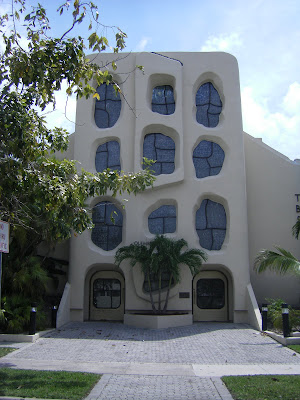
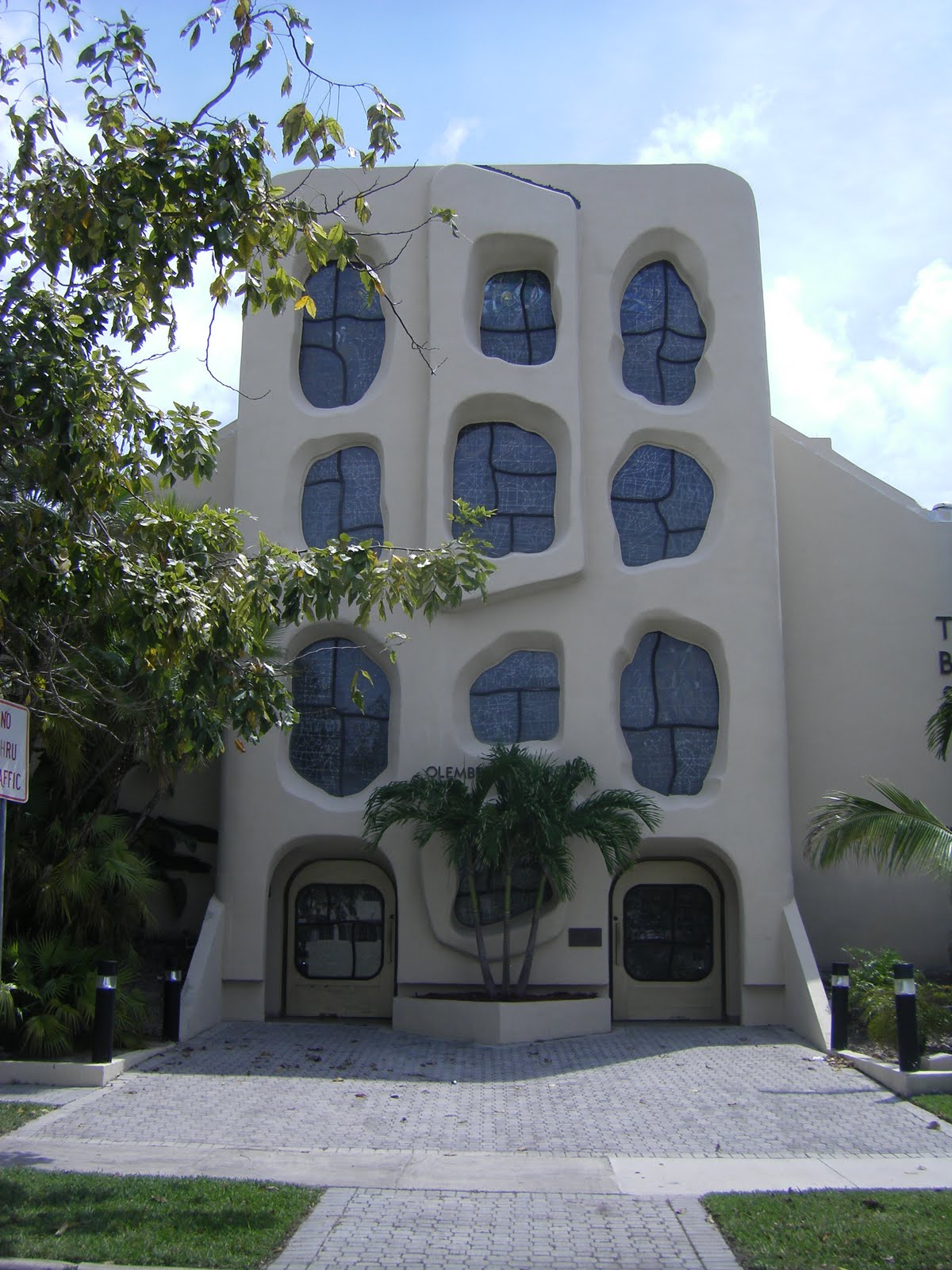
The temple's front windows are blobby; they are like lined up amebas or normal-shaped windows that decided to melt in place. Each one has dark stained glass. There are two front doors, I assume one to enter and the other to exit. These doors have overly rounded corners making them a cross between regular rectangle and an archway. These holes/apertures into the stucco facade remind me of Gaudi's stuff, but I don't see how anybody familiar with architecture wouldn't think this, at least for a second.

Another thing I couldn't help but find intriguing and amusing about it was the fact that it was a Cuban Hebrew Temple. There are a lot of Jewish people in Miami Beach I observed very quickly after moving here. And there are a lot of Cubans, something I already knew. But I didn't really think that those two categories overlapped a whole lot. For some reason I didn't think about it. I guess I simply associate Spanish speaking countries with Catholicism so strongly. I should try not to assume things, because if I had given it any thought whatsoever, I would have maybe realized this assumption was wrong, especially with Cubans, who are such a uniquely defined and separate culture and people. Plus, I remember there was a giant temple I passed all the time in Mexico City and I had found that unusual. I shouldn't assume.
This temple is Miami Beach.

...it kind of seems like the triangular retaining walls were added later. The one on the left actually does retain dirt, that is sort of piled up against the church and held in on both sides by triangles, but the one on the right doesn't retain anything. It doesn't seem structural, so I wonder if it is there for symmetry or to help frame/guide you in. (?).

Temple Beth Shmuel includes a Montessori School (directly adjacent to the cool facade) and the Cuban Hebrew Congregation in the synagogue. It was built in 1981 by Jewish Cuban architect Oscar Sklar. (enough facts).

I didn't get to go inside; it was dark, locked, and the tinted glass blocked my attempts to peer inside through the front doors. The thing is, I didn't know if I really wanted to go inside anyway, because it seemed really dark in there, and anticlimactic. When I was in Italy, there were some churches that were incredible on the outside but dark and almost boring on the inside. It was as if the outside was meant to awe/impress/draw you in but once inside, the walls don't try to compete with the activity and purpose of the space (praying, gathering, etc). I like to think it's like that; I'm not missing anything (architecturally) by remaining outdoors. Maybe I'm wrong...but I don't think it's Corb's Ronchamp, magic on the inside and outside (from what I've read and seen in pictures).

The temple's front windows are blobby; they are like lined up amebas or normal-shaped windows that decided to melt in place. Each one has dark stained glass. There are two front doors, I assume one to enter and the other to exit. These doors have overly rounded corners making them a cross between regular rectangle and an archway. These holes/apertures into the stucco facade remind me of Gaudi's stuff, but I don't see how anybody familiar with architecture wouldn't think this, at least for a second.

I really like it; there is something homey about it that I can't quite put my finger on. The building, from what I could see, is pretty standard except for this entrance. It has a front where it acknowledges the street which is the only part I cared to examine. This facade catches my eye at street level and commanded my attention...even more so than the oversized Frank Gehry building being constructed a couple blocks down or the Hertzog and de Meuron parking garage along Lincoln. I didn't even realize the garage was the famous duo's building, and I didn't realize the huge one under construction was by FG until I ran into it on a blog online. This synagogue pulled me in without online critiques and words.
Another thing I couldn't help but find intriguing and amusing about it was the fact that it was a Cuban Hebrew Temple. There are a lot of Jewish people in Miami Beach I observed very quickly after moving here. And there are a lot of Cubans, something I already knew. But I didn't really think that those two categories overlapped a whole lot. For some reason I didn't think about it. I guess I simply associate Spanish speaking countries with Catholicism so strongly. I should try not to assume things, because if I had given it any thought whatsoever, I would have maybe realized this assumption was wrong, especially with Cubans, who are such a uniquely defined and separate culture and people. Plus, I remember there was a giant temple I passed all the time in Mexico City and I had found that unusual. I shouldn't assume.
This temple is Miami Beach.

...it kind of seems like the triangular retaining walls were added later. The one on the left actually does retain dirt, that is sort of piled up against the church and held in on both sides by triangles, but the one on the right doesn't retain anything. It doesn't seem structural, so I wonder if it is there for symmetry or to help frame/guide you in. (?).
Thursday
I had a meandering day. I went to French Bakery and then no sooner did I sit down and start steeping my tea I read my first email that said I needed to go, within the next hour, to my new agency office. I biked home, got ready, and biked to the agency. It took a whole 15 minutes to take the photos I needed and I wasn't in the mood to bike all the way home again already. My crotch hurt and it was super windy. So I wandered up and down Lincoln Road before I finally decided to gingerly ride a new way home, along back roads.

There is this amazing Cuban Jewish Temple I've passed many times that I've been meaning to photograph, so I pulled my bike over and photographed it.
Riding by the convention center, I passed the Miami Botanical Gardens, which was open to the public for free. I propped and locked my bike. Camera in hand, I wandered the garden; it was lovely; I thought about things.

Adjacent to the garden is a Holocaust Memorial. I've actually passed it many times driving and never noticed it. Not that I didn't see it, I just never thought twice about looking at what it was. Now I know. I even listened in on a high school tour, walked through it, and then sat in on a video (for the high school class) on the making of the memorial.
 After that, I made my way back through the gardens to my bicycle.
The next place I ran into biking was the Miami Beach Public Library. I had noticed it last time I was in Miami briefly, so I decided to wander in; nothing too special, but I looked up Morris Lapidus and immediately scrawled down the numbers to find books even though I knew I couldn't check them out. I only found one of the books on my paper, and sat down and began reading a long essay on him. I decided I'd come back another time, supplied, to finish the essay.
At home I ate and wrote and watched food network. Then I got into my car (I couldn't bring myself to ride anymore through wind and pain) and drove down to Miami Beach Whole Foods. I read for English and then went down the street to make the pilates class I had wanted to make, the only plan I had started the day with. The online info was tricky, well misleading/wrong. I walked out, exercise-free and decided to go to the fantastic Publix supermarket I had spotted the previous night. It looked like some giant glass bugshell...this big protective curve in the front.

I thought this day was refreshing and riveting. I thought I'd write a lot about it because a lot happened and I took a lot of pictures and I had a lot of thoughts and opinions...but instead I've summarized what happened in this quick, easy read. All it's missing is genuine thought, emotion, time, passion, and pictures. The pictures always come last though, because they mess up how the words fit together and on the page. All that other stuff is missing I think because somewhere in the back of my mind, the amount of detail I wanted to put into this post relating to all those places and things seemed overwhelming. Like this would become SUPER POST!
What will happen is that I'll add pictures and publish this post. Then I'll write, individually, about each of those places. That way, it's organized, chopped-up, and arranged like finger food. Pre-portioned and easy.

There is this amazing Cuban Jewish Temple I've passed many times that I've been meaning to photograph, so I pulled my bike over and photographed it.
Riding by the convention center, I passed the Miami Botanical Gardens, which was open to the public for free. I propped and locked my bike. Camera in hand, I wandered the garden; it was lovely; I thought about things.

Adjacent to the garden is a Holocaust Memorial. I've actually passed it many times driving and never noticed it. Not that I didn't see it, I just never thought twice about looking at what it was. Now I know. I even listened in on a high school tour, walked through it, and then sat in on a video (for the high school class) on the making of the memorial.

The next place I ran into biking was the Miami Beach Public Library. I had noticed it last time I was in Miami briefly, so I decided to wander in; nothing too special, but I looked up Morris Lapidus and immediately scrawled down the numbers to find books even though I knew I couldn't check them out. I only found one of the books on my paper, and sat down and began reading a long essay on him. I decided I'd come back another time, supplied, to finish the essay.
At home I ate and wrote and watched food network. Then I got into my car (I couldn't bring myself to ride anymore through wind and pain) and drove down to Miami Beach Whole Foods. I read for English and then went down the street to make the pilates class I had wanted to make, the only plan I had started the day with. The online info was tricky, well misleading/wrong. I walked out, exercise-free and decided to go to the fantastic Publix supermarket I had spotted the previous night. It looked like some giant glass bugshell...this big protective curve in the front.

I thought this day was refreshing and riveting. I thought I'd write a lot about it because a lot happened and I took a lot of pictures and I had a lot of thoughts and opinions...but instead I've summarized what happened in this quick, easy read. All it's missing is genuine thought, emotion, time, passion, and pictures. The pictures always come last though, because they mess up how the words fit together and on the page. All that other stuff is missing I think because somewhere in the back of my mind, the amount of detail I wanted to put into this post relating to all those places and things seemed overwhelming. Like this would become SUPER POST!
What will happen is that I'll add pictures and publish this post. Then I'll write, individually, about each of those places. That way, it's organized, chopped-up, and arranged like finger food. Pre-portioned and easy.
Friday, April 16, 2010
Morris Lapidus, Miami Beach Architect.

Lapidus was born in 1902 in Eastern Europe but his family immigrated to New York when he was very young. He lived the ‘American dream’ growing up poor but gaining riches and fame through hard work and dedication. He graduated from Columbia’s architecture program and worked as a draftsman (he excelled at drawing) and retail interiors/display windows. This background gave him a different perspective and style when he began designing hotels in Miami Beach. (Gray).

"There were three things--took me years to develop--that created an effect which actually stopped people on the street The stores depend on brilliant light, the use of color, and one other thing I noticed: people do not make a beeline for the thing they want to buy. They meander. So I shaped the walls in unusual forms." - Morris Lapidus (Ringer).


Critics didn’t respect Lapidus for the most part, so while he had commissions pouring in from Miami and all over the country, his work was either omitted from architectural journals and writings or harshly criticized.

"I was ruled out of the architecture profession," said Lapidus. "The Fontainebleau--the high point of my career--was never published. Never." (Ringer).

Fontainebleau is a fantasyland. Lapidus designed the resort to be somewhat like Disneyland for grown-ups, containing everything a vacationer may want all rolled into one. Fontainebleau has pools, spas, restaurants, lounges, a nightclub, department stores, boutiques, and incredible suites—all for the guests to enjoy. It’s been the backdrop for movies such as Scarface and James Bond Goldfinger. One of the most infamous parts of the hotel was the ‘stairway to nowhere,’ which was a grandiose/elaborate staircase that led up to the cloak room. The staircase enabled guests’ to make their grand entrance into the room, so all eyes could be on them while they walked down the staircase. In fact, Fontainebleau was so popular that Lapidus was commissioned by the city to ‘revamp’ Lincoln Road, since the hotel’s popularity killed business on this famous street.

Lapidus proposed to close the street to vehicular traffic, enabling restaurants to bleed out into sidewalks, creating one of the first . He also designed playful concrete fountains and a variety of unique shading devices (utilizing different techniques such as cantilevers, barrel vaults, cut-out slabs) interspersed with large tropical gardens in the center of the road. These elements emphasized the idea of procession for the shopper while simultaneously created dynamic spaces for people to sit, explore, pose, people watch, shop, eat, and relax.

Morris Lapidus retired in 1985 and burned years worth of drawings/sketches/projects. Soon after in the late 1980’s and early 1990’s, the ideas of postmodernism became popular, which were embodied in much of Lapidus’s work. Architects began to respect, study, and honor his contributions to American architecture. He died in 2001 at the age of 98 in Miami Beach.
The context of Lapidus's work is what I find most intriguing and incredible. It's as if he was an architect before his time. His pop ideas and whimsical designs were created while the profession swooned over the sterile, international style designs and his concepts and ideas about retail/shopping/public spaces has became an exemplar model for later outdoor malls all over the world. Lapidus responded more directly to what his projects were about and who they were for...which were people, in a country that had just come out of World War II. People wanted to relax, have fun, feel special, and escape.

In school we are taught to rigorously question and reason why there is a curve, color, or cut-out, or anything non-essential or not standardized. But what Lapidus recognized and exploited, was the purpose/function of his projects were to entertain, pamper, and awe people...so all those things we were taught to be critical of and rational in our thinking were essential in themselves. You can't escape the everyday, practical world without throwing it's rigorous logic and rules out. Lapidus's buildings were not logical/practical/straight forward aesthetically or economically, but they were incredibly, incredibly successful. Which counts for so much (in both the real world and the fantasy worlds he created), and seemingly not much in the architectural world. Lapidus understood Las Vegas twenty years before Venturi learned from it. After all, what's so wrong with designing something only for the fun of it?
--------------------------------------------

It's weird: if I had been introduced to Morris Lapidus's stuff with no formal architectural education, I probably would have liked it. If I had read about it in architectural journals or texts, I probably wouldn't have cared for it. But after being in the world's he created (because indeed they are whole new worlds!) I am head over heals for him. After reading about postmodernism and studying Venturi's mom's house or the tower (who's architect I'm blanking out on!) that is like a big piece of furniture, I've always disliked it. It seemed so pointless and fake.
In reading Michael Pollan's book, A Place of My Own, he talks about how he thinks that the Writing House he was building was, in essence, a postmodern hut. I remember reading that part and cringing at the word and thinking how awful it would have been if I had been building a place of my own only to discover it could be labeled 'postmodern.' Eww. Charlie, the architect, didn't seem to love the 'postmodern' label Pollan stamped on the shack either...

But now, after walking along Lincoln Road (tons!) and being in Fontainebleau, purely for the reasons they were designed and built (to escape and have fun!), I love it. His curves, colors, and wit have seduced me. So now am I not only determined to go out of my way to check out the other Lapidus hotels along the strip and read the books he's written (only on reserve at Miami's main library, as opposed to the Miami Beach Branch I visited), but I’m reevaluating my feelings about postmodern architecture. Maybe I need step down off my little architectural pedestal and listen to brain and instincts tell me what I like and how a space makes me feel as opposed to what I’ve read about how I’m supposed to feel.

I've been trying to figure out the best way to put this next thought, but every way sounds kind of stupid so I'm just going to let it be like that: In a girl world, I feel like Lapidus designed the funny guy. It's that guy that becomes more and more attractive the more you are with him, because he makes you feel really good. The one’s you actually fall for and want to spend time with; not the one’s you just want to look at in magazines or from far away.
----------------------------------------
Austin, Tom. "Fontainebleau's Extreme Makeover." Travel + Leisure. March 2009. 16 April 2010 http://www.travelandleisure.com/articles/fontainebleau-hotels-extreme-makeover/1.
Gray, Christopher. "An Architect Who Delighted in the Flamboyant." New York Times. 10 April 2005. 15 April 2010 http://www.nytimes.com/2005/04/10/realestate/10scap.html?_r=1.
"Miami Beach History: Morris Lapidus Biography." Miami Beach 411. 2009. 16 April 2010 http://www.miamibeach411.com/History/bio_lapidus.html.
Mizrahi, Adam. "Morris Lapidus at Lincoln Road." Urban City Architecture. 5 October 2005. 16 April 2010 http://www.urbancityarch.com/2009/10/morris-lapidus-at-lincoln-road/.
"Morris Lapidus." New York Times. 16 April 2010 http://topics.nytimes.com/topics/reference/timestopics/people/l/morris_lapidus/index.html.
Ringer, Jonathan. "Lapidus of Luxury." Metropolis Magazine. 2007. 16 April 2010 http://www.metropolismag.com/html/content_0101/ml.htm.
http://www.fontainebleau.com/
Sunday, April 11, 2010
mushrooming thoughts
Pollan does this wonderful job of tying in these poetic threads in architectural theory and history into his little building. I particularly savored his thoughts on the sort of place he was building, Writing House. He explored a person's place of their own, a study, and how it evolved out this notion as an oversized, inhabitable desk. A piece of furniture turned room. It's deep woods turned built-in bookshelves. Intimacy and privacy left the lock and key drawer for the room door. It was Man sanctuary; a cozy nook for his thoughts.
His words reminisce and meander and linger and coalesce with Stilgoe's theories and histories. The difference is that sometimes I feel like Stilgoe tries to hammer it into the reader/Explorer. While enabling the reader to look around his/her surroundings in a new way, Stilgoe, at the same time, seems to accuse and resent the reader for his/her blindness and ignorance in the first place. I never get that feeling from Pollan because he never claims that architecture (well, the thoughts he is exploring in the book) are 'his thing.' He never studied or even attempted to study architecture before embarking on building Writing House or writing this particular book, so he doesn't pretend his observations are more than they are and he doesn't write as if the reader should have already been asking the same questions or exploring the same issues. He maintains an innocent stance; the house was always a project/hobby; not proof of his depth and architectural knowledge. I like that.
I went to B&N and read Spring, Summer, Autumn, Fall. A year of Marcovaldo borrowed. (My copy, coincidentally, I left in Miami. My plans keep changing, I keep staying in Naples longer than I planned, so Marcovaldo sits on a marble windowsill in South Beach.) Marcovaldo is fantastically naive, foolish, insecure, petty, whimsical, and real. He makes those mistakes and feels those emotions/feelings that we call 'human.'
The mushroom story is perfect and reminds me of how a lot people, including me, are about music. They like it when it is 'underground' and not a lot of people know about the band/singer...but as soon as the music is played on the radio/tv/movies, it's no longer as good as it used to be (for some reason)and they just stop listening to it because it's too 'mainstream.' It then becomes the music they (I) 'used to listen to, before anyone knew what it was.'
Exclusivity has allure. Fashion (like music) is alluring. I am being seduced by fashion. I walked in my second fashion show today.
His words reminisce and meander and linger and coalesce with Stilgoe's theories and histories. The difference is that sometimes I feel like Stilgoe tries to hammer it into the reader/Explorer. While enabling the reader to look around his/her surroundings in a new way, Stilgoe, at the same time, seems to accuse and resent the reader for his/her blindness and ignorance in the first place. I never get that feeling from Pollan because he never claims that architecture (well, the thoughts he is exploring in the book) are 'his thing.' He never studied or even attempted to study architecture before embarking on building Writing House or writing this particular book, so he doesn't pretend his observations are more than they are and he doesn't write as if the reader should have already been asking the same questions or exploring the same issues. He maintains an innocent stance; the house was always a project/hobby; not proof of his depth and architectural knowledge. I like that.
I went to B&N and read Spring, Summer, Autumn, Fall. A year of Marcovaldo borrowed. (My copy, coincidentally, I left in Miami. My plans keep changing, I keep staying in Naples longer than I planned, so Marcovaldo sits on a marble windowsill in South Beach.) Marcovaldo is fantastically naive, foolish, insecure, petty, whimsical, and real. He makes those mistakes and feels those emotions/feelings that we call 'human.'
The mushroom story is perfect and reminds me of how a lot people, including me, are about music. They like it when it is 'underground' and not a lot of people know about the band/singer...but as soon as the music is played on the radio/tv/movies, it's no longer as good as it used to be (for some reason)and they just stop listening to it because it's too 'mainstream.' It then becomes the music they (I) 'used to listen to, before anyone knew what it was.'
Exclusivity has allure. Fashion (like music) is alluring. I am being seduced by fashion. I walked in my second fashion show today.
Friday, April 9, 2010
Memory Construction
Finally I finished reading A Place of My Own by Michael Pollan. I felt exhilarated, like I just jumped off the top of Nostalgia Falls.
I used to have this morning routine. I would wake up early, start heating up some water for tea and make myself a small bowl of granola, fruit, and yogurt. I would gingerly set the pretty bowl (frosted glass), steeping tea (ceramic 'Grampa' mug), and a glass of water (again, frosted glass) on a barstool next to a corner of our couch in our living room, open the windows (right behind the couch), play our one Nora Jones CD, and read a book. Usually, this was a cookbook. I would read it line-by-line, admiring the vivid photos and absorbing the recipes like they were thoughtful, corky, short-stories. Today, A Place of My Own was my recipe, an ash desk outline was my food photo.
This particular corner of the couch + time of morning + open windows + NJ playing was my own way of building my Writing House. Instead of a house, it was Model Body; instead of Joe (the invaluable carpenter that helped the author, Michael, build Writing House), it was food; instead of weekends, it was mornings.
Sitting there today brought back this feeling of excitement, achievement, purity/cleanness of my body, spirit, and mind...all the things that I associate with my cookbook fairytale mornings. It's strange how I think so highly of these mornings, because everything else going on in my life at the time wasn't all that great. I've almost completely erased and forgotten all the negative stuff from then.
But I think people's brains tend to that; or at least mine does. I tend to exaggerate emotions and feelings when I remember things. If, overall, something good was left behind in my mind, then all the stuff that supports that become magnified; likewise, when I recall an overall feeling of sadness or pain, then all the stuff that made me feel that way becomes exaggerated while the happy moments become downplayed and ring false.
In this case, a cozy feeling of goodness was left behind; these morning memories radiate/project/embody aaammmmazzzzingness. I had been building a place of my own (I just hadn't quite realized it).
I used to have this morning routine. I would wake up early, start heating up some water for tea and make myself a small bowl of granola, fruit, and yogurt. I would gingerly set the pretty bowl (frosted glass), steeping tea (ceramic 'Grampa' mug), and a glass of water (again, frosted glass) on a barstool next to a corner of our couch in our living room, open the windows (right behind the couch), play our one Nora Jones CD, and read a book. Usually, this was a cookbook. I would read it line-by-line, admiring the vivid photos and absorbing the recipes like they were thoughtful, corky, short-stories. Today, A Place of My Own was my recipe, an ash desk outline was my food photo.
This particular corner of the couch + time of morning + open windows + NJ playing was my own way of building my Writing House. Instead of a house, it was Model Body; instead of Joe (the invaluable carpenter that helped the author, Michael, build Writing House), it was food; instead of weekends, it was mornings.
Sitting there today brought back this feeling of excitement, achievement, purity/cleanness of my body, spirit, and mind...all the things that I associate with my cookbook fairytale mornings. It's strange how I think so highly of these mornings, because everything else going on in my life at the time wasn't all that great. I've almost completely erased and forgotten all the negative stuff from then.
But I think people's brains tend to that; or at least mine does. I tend to exaggerate emotions and feelings when I remember things. If, overall, something good was left behind in my mind, then all the stuff that supports that become magnified; likewise, when I recall an overall feeling of sadness or pain, then all the stuff that made me feel that way becomes exaggerated while the happy moments become downplayed and ring false.
In this case, a cozy feeling of goodness was left behind; these morning memories radiate/project/embody aaammmmazzzzingness. I had been building a place of my own (I just hadn't quite realized it).
Subscribe to:
Posts (Atom)